
Yacht Build Cost: Realistic Budgets for First-Time Owners

Building a new yacht in the United States runs from the low hundreds of thousands for a production cruising sailboat to high multi-millions for a fully custom motor yacht, and can reach significantly more for a large superyacht. The number most first-time owners miss is this: the shipyard contract price is not the total project cost. Design fees, classification surveys, owner-side insurance, project management, and a realistic contingency reserve routinely add a substantial percentage on top of the headline build figure. Commission a preliminary budget and engage an owner’s representative before you sign anything.
Quick price snapshot (U.S. yard baseline, new-build, turnkey):
- Small production cruising yacht (30–50 ft): $300,000–$1M
- Mid-size semi-custom or custom motor/sailing yacht (50–80 ft): $1M–several million
- Fully custom yacht (80–100 ft): multi-million
- Superyacht (100 ft and above): costs increase significantly with size and bespoke features
Refer to the vessel size and build type table below for detailed context and typical price progression by size.
Before you accept any shipyard quote, verify three things:
- Scope: Is the price turnkey (fully outfitted and commissioned) or hull-and-deck only?
- Classification: Does the quote include class society fees, flag-state registration, and compliance surveys?
- Contingency: Is a contingency line item included, and at what percentage?
If any of those three are absent, the number on the page is not a real project budget.
Table of Contents
- What does a yacht build cost by size and type?
- What drives yacht build costs the most?
- How does a build budget break down across major categories?
- What soft costs do owners forget to budget?
- Why does independent project management reduce your budget risk?
- What are the real annual costs of owning a yacht?
- What is the typical build timeline and when do payments fall due?
- New build, pre-owned, or refit: which makes financial sense?
- How do you build a defensible owner budget?
- Anonymized example budgets: small, mid, and superyacht
- Key Takeaways
- The budget mistake that costs owners the most
- Yachtconsultinggroup: independent oversight from first budget to delivery
- Useful sources for further research
What does a yacht build cost by size and type?
Typical mid-sized new-builds in the 40–70 ft range span roughly $600,000 to $8 million, with the spread driven almost entirely by whether the vessel is a production design, semi-custom, or fully bespoke build. The table below maps realistic ranges to vessel size and build type, using a U.S. yard baseline, new-build condition, and a turnkey scope that includes outfitting and commissioning.
| LOA Range | Build Type | Estimate Range | Key Assumptions |
|---|---|---|---|
| 30–50 ft | Production | starting in the low hundreds of thousands up to around $1M | Standard finish, fiberglass hull, basic electronics |
| 50–80 ft | Semi-custom | from around $1M to several million | Mid-spec interior, diesel propulsion, moderate systems |
| 80–100 ft | Fully custom | in the multi-million | High-spec interior, advanced MEP, naval architecture |
| 100 ft+ | Superyacht | costs increase significantly with size and bespoke features | Bespoke everything, class society, full crew quarters |
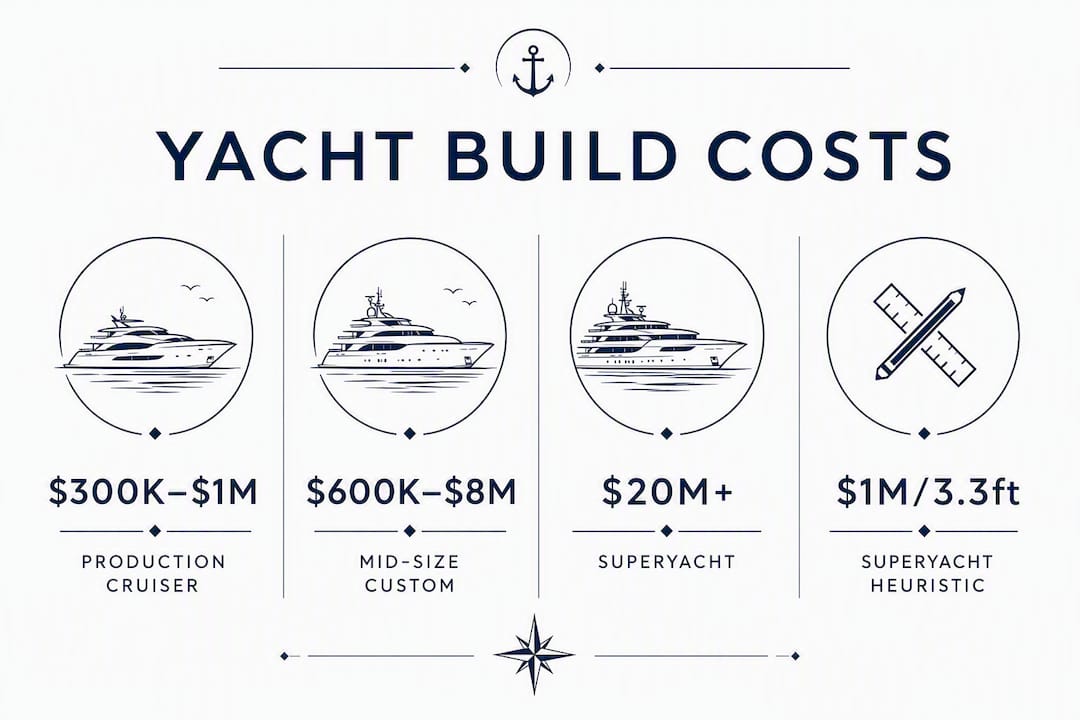
Assumptions: USD pricing, U.S. or comparable Western yard, turnkey scope. Hull-only contracts run 30–50% lower but exclude all outfitting, systems, and commissioning costs. Classification under a recognized society (ABS, Lloyd’s, DNV) adds to soft costs and is not reflected in the ranges above.
A few specification choices move numbers dramatically within each band. An expedition-capable 75-footer built for offshore passagemaking needs redundant propulsion, extended fuel capacity, reinforced hull plating, and satellite communications systems that a coastal cruiser of the same length simply does not. That package can push a $3.5M mid-range estimate toward $6M before a single piece of custom joinery is ordered. Hybrid or diesel-electric propulsion on a 60-footer typically carries a premium of 15–25% over a conventional diesel installation, depending on battery bank size and generator configuration.
For large custom builds, a rough per-foot heuristic places higher-end superyachts around $1 million per 3.3 feet of length overall, though this benchmark flattens at smaller sizes and accelerates sharply for vessels above 150 feet where engineering complexity compounds.
What drives yacht build costs the most?
Length overall is the single biggest lever. Every foot of additional LOA increases structural material, systems runs, interior volume, and crew requirements simultaneously. But LOA is only the starting point.
Primary cost drivers, roughly in order of impact:
- Hull material: Fiberglass (GRP) is the baseline. Aluminum adds 10–20% to hull fabrication costs but saves weight and simplifies repairs offshore. Carbon fiber composite can double or triple hull fabrication costs but delivers significant weight savings that reduce fuel burn and improve performance over the vessel’s life.
- Propulsion type: Conventional diesel is the cost baseline. Hybrid diesel-electric systems carry a 15–25% premium on the propulsion package. Fully electric propulsion for offshore-capable vessels remains expensive and range-limited; it makes sense for day boats and short-range vessels, not bluewater passages.
- MEP complexity: Mechanical, electrical, and plumbing systems on a bespoke build are where budgets quietly balloon. Redundant generators, watermakers, stabilization systems, HVAC zoning, and integrated bridge systems each add cost independently, and their installation requires skilled integration labor that is billed separately from equipment purchase.
- Interior fit-out level: A production-grade interior uses standard cabinetry, off-the-shelf fixtures, and catalog hardware. A bespoke interior with custom joinery, stone countertops, hand-stitched upholstery, and integrated audio-visual systems can cost three to five times as much for the same square footage.
- Naval architecture and engineering: A proven production design amortizes design costs across many hulls. A one-off design means you pay for every calculation, drawing, and engineering review from scratch.
- Shipyard location and reputation: Labor rates vary enormously by region. U.S. yards carry higher labor costs than yards in Turkey, Poland, or Southeast Asia, but proximity simplifies owner oversight, reduces travel costs, and avoids import duties on the finished vessel.
- Owner-driven change orders: This is the silent budget killer. Every change made after engineering is complete costs two to four times what it would have cost during the design phase.
Labor efficiency and upfront engineering precision control final costs more reliably than hull material choice alone. Owners who lock scope early and resist mid-build changes consistently come in closer to their original estimates.
Pro Tip: The largest predictable savings come from fixing the full specification before the shipyard contract is signed. Standard equipment packages, bulk-procurement of electronics and hardware, and a complete set of engineering drawings at contract signing can reduce change-order exposure by a meaningful margin on any build above $2M.

How does a build budget break down across major categories?
On a mid-specification custom build, the hull shell typically represents a smaller share of total cost than most owners expect. Interior fit-out and MEP systems frequently eclipse hull material costs on high-end, one-off projects.
Here is how a typical budget allocates across major categories on a bespoke 70–80 ft motor yacht:
- Hull and structure: 15–25% of total build cost
- Mechanical, electrical, and plumbing (MEP): 20–30%
- Interior fit-out (joinery, upholstery, stone, fixtures): 20–35%
- Deck hardware, rigging, and navigation systems: 8–15%
- Labor (yard and subcontractors): 25–40% on bespoke builds
The ranges overlap because specification level shifts the proportions. A high-spec interior on a 75-footer can consume 35% of the total budget while the hull sits at 15%. On a production vessel, those ratios nearly invert.
Interior materials and specialized hardware on bespoke builds can account for 4–6 times the cost of the hull shell alone. The vessel you see in the brochure is mostly furniture, systems, and craftsmanship — not steel or fiberglass.
Common underestimated line items that routinely surprise first-time owners:
- Bespoke joinery: Custom cabinetry with exotic veneers, integrated lighting, and precision hardware runs far beyond catalog estimates.
- Audio-visual and entertainment systems: A full-vessel AV package with integrated control systems, outdoor speakers, and satellite TV can easily reach $200,000–$500,000 on a large custom build.
- Specialized hardware: Hydraulic passerelles, custom anchor systems, and bespoke deck fittings are priced individually and add up fast.
- Yard markups on materials: Most yards apply a materials margin of 10–20% on owner-supplied or yard-procured equipment. This is standard practice but must be negotiated and documented in the contract.
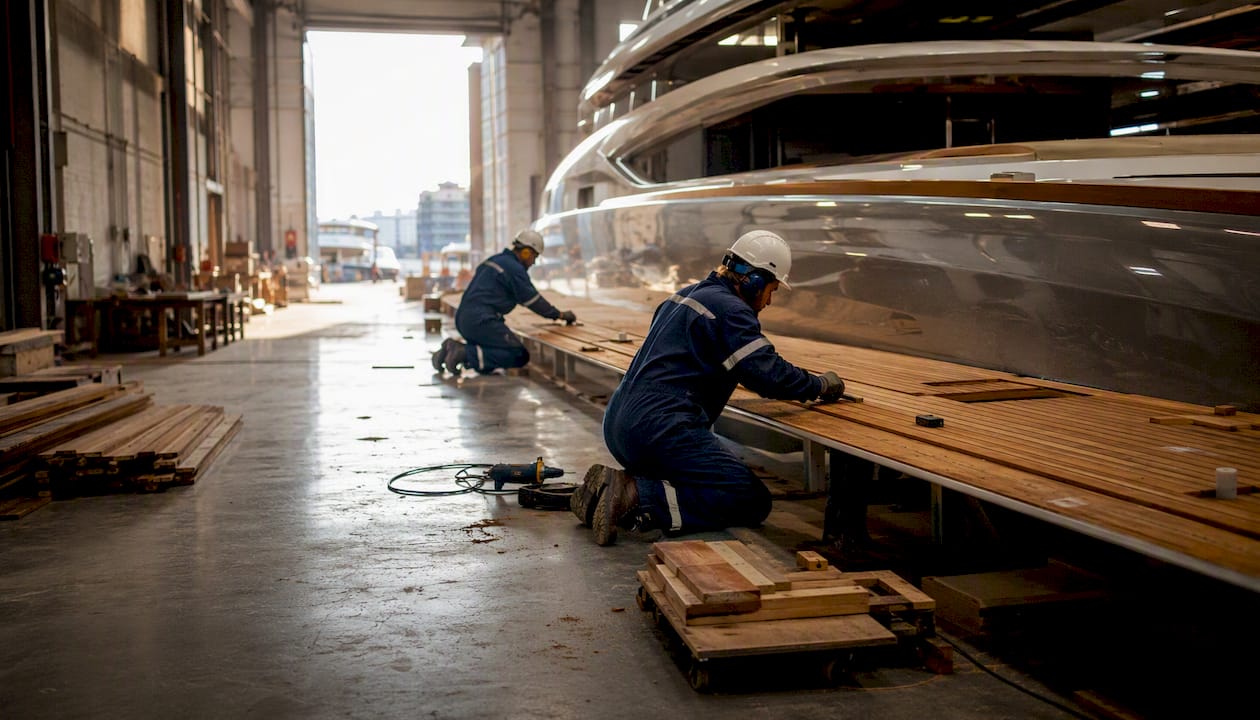
Labor costs can equal or exceed material costs on bespoke projects, particularly when skilled subcontractors are brought in for specialized trades like composite fabrication, electrical integration, or custom metalwork.
What soft costs do owners forget to budget?
The shipyard contract price covers what the yard builds. It rarely covers what the owner must spend to get the project to the water legally, safely, and on terms that protect the owner’s investment.
Soft costs to budget separately:
- Naval architecture and design fees: 3–8% of total build cost on a custom design; lower on semi-custom where design is partially amortized
- Classification society fees (ABS, Lloyd’s, DNV): Typically $50,000–$300,000+ depending on vessel size and class notation; required for commercial use or charter
- Flag-state registration and legal: $5,000–$50,000 depending on flag, entity structure, and legal complexity
- Owner-side insurance during construction: Marine builders risk insurance runs roughly 0.5–1.5% of the vessel’s insured value annually
- Project management and owner’s representative: 3–8% of total project cost for a full-service independent PM engagement
- Sea trials, acceptance testing, and delivery: Travel, crew costs, fuel, and any punch-list remediation
- Initial provisioning and outfitting: Linens, safety equipment, spare parts, and initial stores are rarely included in a yard contract
Design fees, classification, surveys, project management, and owner-side legal and insurance are material costs that headline build prices routinely omit. Budget them as a separate line from day one.
Contingency: Industry practice recommends 10–15% contingency on a well-specified semi-custom build and 15–20% on a fully bespoke one-off. If the design is still evolving at contract signing, 20% is not excessive.
Hidden line items including docking, storage, insurance during construction, cranage, transport, and commissioning can add 5–15% to the base estimate on their own.
Pro Tip: Negotiate milestone-based payment schedules tied to physical deliverables, not calendar dates. Pair this with an escrow mechanism for the final 10–15% of the contract price, held until acceptance testing is complete and all punch-list items are resolved. This is the single most effective contractual protection an owner has.
Why does independent project management reduce your budget risk?
An owner’s representative is not a luxury on a custom build. On any project above $1M, independent oversight typically pays for itself through avoided change orders, caught specification deviations, and negotiated remediation before defects become disputes.
The role of an independent project manager spans every phase:
- Pre-contract technical due diligence: Review yard capability, financial stability, and reference projects before signing.
- Design review and specification audit: Confirm the engineering drawings match the owner’s brief and that nothing is left ambiguous.
- Procurement oversight: Verify that specified equipment is actually ordered and that substitutions are flagged and approved.
- Construction surveillance: Regular yard visits, milestone inspections, and photographic documentation of structural work before it is closed in.
- Quality inspections and punch-list management: Systematic defect tracking from outfitting through commissioning.
- Sea trials and acceptance: Independent verification that the vessel performs to specification before final payment is released.
- Contract negotiation support: Ensuring warranty terms, liquidated damages clauses, and change-order procedures protect the owner.
Consider a scenario that plays out regularly on mid-size custom builds: a yard substitutes a lower-specification generator during outfitting, citing “equivalent performance.” Without an independent PM reviewing the procurement records, the owner may not discover the substitution until sea trials, at which point remediation requires removing cabinetry and replumbing exhaust runs. The cost of that fix, plus the schedule delay, typically exceeds a full year of PM fees.
Owners who engage early technical due diligence and independent oversight reduce the risk of expensive change orders and scope creep during outfitting.
Pro Tip: Hire the independent project manager before the shipyard contract is signed, not after. The PM’s most valuable work happens during contract negotiation and specification review. A PM brought in after signing can manage problems; one brought in before signing can prevent them. Look for licensed captains and marine engineers with verifiable project histories, not generalist consultants.
What are the real annual costs of owning a yacht?
The build price is a one-time event. Annual operating costs are permanent. The industry’s 10% rule estimates annual running costs at roughly 10% of the vessel’s value, with realistic ranges of 10–20% depending on vessel complexity, crew size, and usage patterns.
Typical annual cost line items:
- Crew: The largest single operating cost on crewed vessels. A captain alone runs $80,000–$150,000+ annually; a full crew for a 100-foot superyacht can exceed $500,000 per year.
- Fuel: Highly variable by usage. A 60-foot motor yacht burning 30 gallons per hour at cruise speed can spend $50,000–$150,000 annually on fuel depending on hours underway.
- Maintenance and repairs: Planned maintenance, antifouling, engine servicing, and unplanned repairs typically run 3–5% of vessel value annually.
- Insurance: 1–2% of insured value annually for a well-maintained, owner-operated vessel in U.S. waters; higher for charter use.
- Berthing and marina fees: Major U.S. marinas charge $150–$400+ per foot per year for annual slips; premium locations in Florida, New England, or the Pacific Northwest run higher.
- Major refits: Plan for a significant refit every 5–7 years. A mid-life refit on a 70-foot motor yacht can run $500,000–$2M depending on scope.
| Vessel Profile | Annual Operating Cost (Est.) | Key Assumptions |
|---|---|---|
| 40 ft cruising sailboat | varies by usage and operation | Owner-operated, U.S. coastal, minimal crew |
| 70–80 ft custom motor yacht | varies with crew and usage | Part-time captain, moderate usage, U.S. waters |
| 110 ft superyacht | can be very high depending on crew and use | Full crew, active use, international cruising |
Budget for equipment lifecycle replacement separately from routine maintenance. Watermakers, generators, and navigation electronics have finite service lives; replacing them on a 15-year-old vessel is not a refit, it is a capital expense.
What is the typical build timeline and when do payments fall due?
Timeline varies sharply by build type. A production yacht can be ordered and delivered in 6–18 months. A semi-custom build typically runs 18–36 months. A fully custom superyacht from contract to delivery commonly takes 3–5 years, and complex megayacht projects have run longer.
Payment milestones on a typical new-build contract follow this general structure:
- Contract signing / design deposit: 10–20% of contract price, due at signing
- Keel-laying or hull commencement: 10–20%, due when structural fabrication begins
- Hull completion / launching: 15–25%, due at hull launch or major structural milestone
- Outfitting completion / pre-trials: 20–30%, due when the vessel is substantially outfitted
- Sea trials and acceptance: 10–15%, due upon successful completion of sea trials
- Delivery: Final 5–15%, released upon delivery and punch-list sign-off
These percentages are negotiable and vary by yard, contract type, and project size. Lump-sum contracts tend to front-load payments; cost-plus contracts draw down against actual expenditure with monthly or quarterly reconciliation.
Shorter build schedules reduce time-related holding costs but typically increase per-month labor premiums. Accelerating a 36-month build to 24 months requires overtime labor, parallel-path subcontracting, and expedited equipment procurement, all of which carry cost premiums. The math only favors acceleration when the owner’s time-value-of-money calculation clearly justifies it.
Milestone payment schedules that align with physical deliverables reduce owner exposure by ensuring money flows only when verifiable progress has been made.
New build, pre-owned, or refit: which makes financial sense?
The right answer depends on three variables: how much customization you need, how quickly you want to be on the water, and how much financial risk you can absorb.
New build gives you exactly what you specify, with full warranty coverage and no hidden history. The trade-off is time (2–5 years to delivery) and the full cost of a bespoke project. Depreciation is front-loaded; a new custom yacht loses value the moment it is commissioned, though well-specified vessels from reputable yards hold value better than production boats.
Pre-owned purchase delivers immediate availability and a known commodity. A well-maintained 10-year-old 70-footer might sell for 40–60% of its original build cost, which looks like a bargain until you account for the survey findings, deferred maintenance, and the systems upgrades needed to bring it to current standards. Budget a minimum of 10–15% of the purchase price for immediate post-purchase work on any pre-owned vessel above 15 years old.
Refit is the most financially unpredictable path.
The rule of thumb used by experienced project managers: if a refit budget exceeds 50% of the vessel’s post-refit market value, a new build or pre-owned purchase deserves serious reconsideration. Refit costs routinely exceed initial estimates by 20–40% because the full condition of hidden structure, wiring, and plumbing is unknown until the vessel is opened up.
Insurance and financing also differ by path. New builds can be financed during construction with marine construction loans; pre-owned vessels qualify for standard marine mortgages; refits are typically self-funded or financed through personal credit lines because lenders are reluctant to secure against a vessel mid-refit.
How do you build a defensible owner budget?
Start with the ranges in this article and work toward specificity through a structured process. A preliminary budget built before yard selection is not a cost estimate; it is a decision-making tool.
- Define the vessel: LOA, hull material, propulsion type, accommodation layout, and primary use case. Every ambiguity at this stage becomes a cost range in the budget.
- Establish the base build cost: Use per-foot benchmarks and the size/type ranges above as a starting point. Apply the appropriate build type (production, semi-custom, fully custom).
- Add soft costs as a separate line: Design and engineering (3–8%), classification (budget $50,000–$300,000+ depending on size), owner-side insurance, legal, and project management (3–8%).
- Add contingency: 10–15% for a well-specified semi-custom build; 15–20% for a fully bespoke one-off.
- Add annual operating reserve: Budget 10–15% of the vessel’s value annually for the first three years of ownership.
- Stress-test the total: If the sum of build cost, soft costs, contingency, and three years of operating costs exceeds your available capital by more than 20%, revisit the specification or the LOA before engaging yards.
Questions to ask every yard before accepting a quote:
- What exactly is included in this price? Provide a line-item scope of work.
- What is explicitly excluded? (Soft costs, owner-furnished equipment, commissioning fuel?)
- What are the payment milestones and the conditions that trigger each payment?
- What classification society is specified, and who pays for surveys?
- What is the warranty period and what does it cover?
- What is the change-order process and how are changes priced?
- What are the liquidated damages provisions for schedule overruns?
Red flags in a yard quote: vague scope descriptions, no milestone detail, missing classification provisions, no change-order procedure, and any quote that arrives within 48 hours of a complex specification request.
Pro Tip: Run a quick sanity check on any yard quote by dividing the total price by the vessel’s LOA in feet. Compare that per-foot figure against the benchmarks in the size table above for the build type. A quote that comes in significantly below the typical range for its category is not a bargain; it is a scope question. Get the exclusions list in writing before you celebrate.
Anonymized example budgets: small, mid, and superyacht
These three examples illustrate how real project totals form from component parts. All figures are U.S.-baseline estimates; actual costs will vary by yard, specification, and market conditions.
| Budget Category | 40 ft Production Cruiser | 70 ft Custom Motor Yacht | 110 ft Superyacht |
|---|---|---|---|
| Hull and structure | — | varies, typically starting at $1.5M+ for 70 ft | starts at several million for 110 ft and up |
| MEP systems | $80,000 | several hundred thousand to multiple millions | increases significantly for superyachts |
| Interior fit-out | — | several hundred thousand to multiple millions | increases sharply with bespoke interior |
| Deck hardware and nav | $40,000 | $500,000 | $600,000 and up |
| Labor (yard + subs) | — | significant, can match or exceed materials | very high for bespoke, complex vessels |
| Soft costs (design, class, PM, legal) | $80,000 | usually 20–35% of base contract | usually 20–35% of base contract |
| Contingency (10–15%) | $50,000 | 10–15% of total project budget | 10–15% of total project budget |
| Estimated project total | ~$500,000 | several million to $20M+ | starts at $20M, can exceed $100M |
Assumptions: USD, U.S. yard baseline, new-build, turnkey scope. The 40 ft cruiser uses a production GRP hull with standard finish. The 70 ft motor yacht uses an aluminum hull, diesel propulsion, and high-spec interior. The 110 ft superyacht uses steel hull, diesel-electric propulsion, full ABS classification, and bespoke interior throughout. Tenders and toys are excluded from all three.
What moved the numbers in each case:
- 40 ft cruiser: Production design and standard equipment packages kept costs controlled. The biggest variable is electronics specification; a full offshore electronics suite can add $40,000–$80,000 to this budget.
- 70 ft motor yacht: The aluminum hull added roughly 15% to hull fabrication versus GRP, but the high-spec interior was the dominant cost driver, consuming nearly 18% of the total project budget.
- 110 ft superyacht: Classification under ABS and full crew quarters added approximately $12M in soft costs and systems complexity that would not appear on a private, unclassed vessel of similar size.
Key Takeaways
Building a new yacht costs far more than the shipyard contract price alone: soft costs, contingency, and annual operating reserves routinely add 30–50% on top of the headline build figure, making total cost of ownership the only number that matters.
| Point | Details |
|---|---|
| Build cost ranges by size | Production cruisers start around $300K–$1M; custom motor yachts start at $1M, with multi-million ranges for larger or fully bespoke builds; superyacht costs increase sharply with size and customization and can exceed $20M. |
| Soft costs are not optional | Design, classification, PM, legal, and insurance during construction add 20–35% beyond the shipyard contract price. |
| Interior and MEP dominate | On bespoke builds, interior fit-out and MEP systems frequently cost 4–6x the hull shell, making specification choices the biggest budget lever. |
| Annual operating costs | Budget 10–20% of vessel value per year for crew, fuel, maintenance, insurance, and berthing; plan for a major refit every 5–7 years. |
| Yachtconsultinggroup’s role | Independent project management from Yachtconsultinggroup, engaged before contract signing, reduces change-order risk and protects owner interests across every build phase. |
The budget mistake that costs owners the most
The most common financial error in a custom yacht build is not choosing the wrong yard or the wrong hull material. It is signing a contract before the specification is complete.
Every ambiguity in a shipyard contract becomes a negotiation later, and that negotiation always happens at the worst possible time: when the vessel is half-built, the owner is emotionally committed, and the yard holds all the leverage. A vague scope description is not an oversight; it is a structural advantage for the yard in every future change-order conversation.
Owners who treat the pre-contract phase as a formality, rushing to sign because they are excited about the project, consistently pay more than owners who spend three to six months on specification, engineering review, and contract negotiation before committing a dollar. The difference is not marginal. On a $5M build, a poorly negotiated contract with ambiguous scope can cost $500,000–$1.5M in change orders that a tighter contract would have prevented entirely.
The second most expensive mistake is underestimating operating costs. A vessel that fits the build budget but strains the operating budget becomes a liability within two years of delivery. The 10% annual rule is a starting point; for actively used, crewed vessels, 15–20% is closer to reality. Owners who model total cost of ownership before committing to a build specification make better decisions about LOA, crew requirements, and propulsion choice than those who focus exclusively on the build price.
Independent oversight is not a cost center. It is the mechanism by which the owner’s interests are represented in a process where every other party, the yard, the designers, the equipment suppliers, has a financial incentive that does not perfectly align with the owner’s. That misalignment is structural, not personal, and it exists on every project regardless of how reputable the yard is.
Yachtconsultinggroup: independent oversight from first budget to delivery
Owners who have been through a custom build once rarely go through a second one without independent representation. The first build teaches the lesson; the question is how expensive that education needs to be.

Yachtconsultinggroup provides independent project management and marine engineering oversight for custom yacht builds, refits, and restorations, with no commercial ties to any shipyard. The team of licensed captains and marine engineers works exclusively for the owner, from preliminary budget review through contract negotiation, construction surveillance, sea trials, and commissioning. With over 50 vessels delivered, the firm’s build management services cover the full project lifecycle, and the published fee schedule makes the cost of engagement transparent from the first conversation.
For owners at the budget-planning stage, the practical next step is a preliminary project review: a structured assessment of your specification, a realistic cost range with assumptions documented, and an honest evaluation of which yards and designers fit your project. Start with the owner’s build guide to understand how the process works, then contact Yachtconsultinggroup directly to discuss your project scope and timeline.
Useful sources for further research
Authoritative references for cost modeling, classification standards, and construction best practices:
- Yacht Construction Guide: Types, Timeline, and Costs | Mastt — Practical overview of build types, timeline ranges, and the 10% annual operating cost rule. Useful for operating-cost modeling and timeline planning.
- How Much Does It Cost to Build a Yacht? | North Pacific Yachts — Owner-focused cost guide with practical guidance on independent oversight and change-order risk. Supports the project management section.
- American Boat and Yacht Council (ABYC) — The primary U.S. standards body for recreational and commercial vessel construction. Relevant for understanding compliance requirements that affect build specifications and insurance.